Disclosure: The First Pick takes part in affiliate programs. If you buy through a link on this page, we may earn a commission at no extra cost to you. Prices, promotions and availability change, so always confirm details on the seller’s page. See our Affiliate Disclosure.
For a portable charger for travel, a 10,000 to 20,000 mAh power bank with USB-C fast charging is enough. Airlines generally allow power banks up to 100 watt-hours in carry-on bags only, and 10,000 to 20,000 mAh models are comfortably under that limit. Check the printed watt-hour rating, choose a reliable cable and confirm your airline’s current rules for using power banks in flight.
How much capacity do you need?
Capacity is usually listed in milliamp-hours (mAh). A typical phone battery holds about 3,000 to 5,000 mAh, but real-world efficiency is lower than the listed number, so a 10,000 mAh power bank usually gives around two full phone charges.
| Capacity | Approx. energy* | Good for |
|---|---|---|
| 10,000 mAh | About 37 Wh | One day out, or a phone and earbuds |
| 20,000 mAh | About 74 Wh | Multiple days, phone plus tablet |
| 26,800 mAh | About 99 Wh | Near the 100 Wh airline limit, for heavy users |
*Approximate watt-hours (Wh) = mAh x 3.7 V / 1000, using the common 3.7V cell rating. Always trust the Wh number printed on the device, if it has one.
Airline rules to check
- Power banks and spare lithium batteries must generally travel in carry-on baggage, not checked bags.
- The common limit is 100 Wh per battery without airline approval. Larger batteries require approval and are subject to stricter limits.
- Some airlines have rules on using or charging power banks during flights. Check the current policy of your airline before you fly.
- Protect terminals from short circuits by keeping the power bank in a pouch or original packaging.
Features worth having
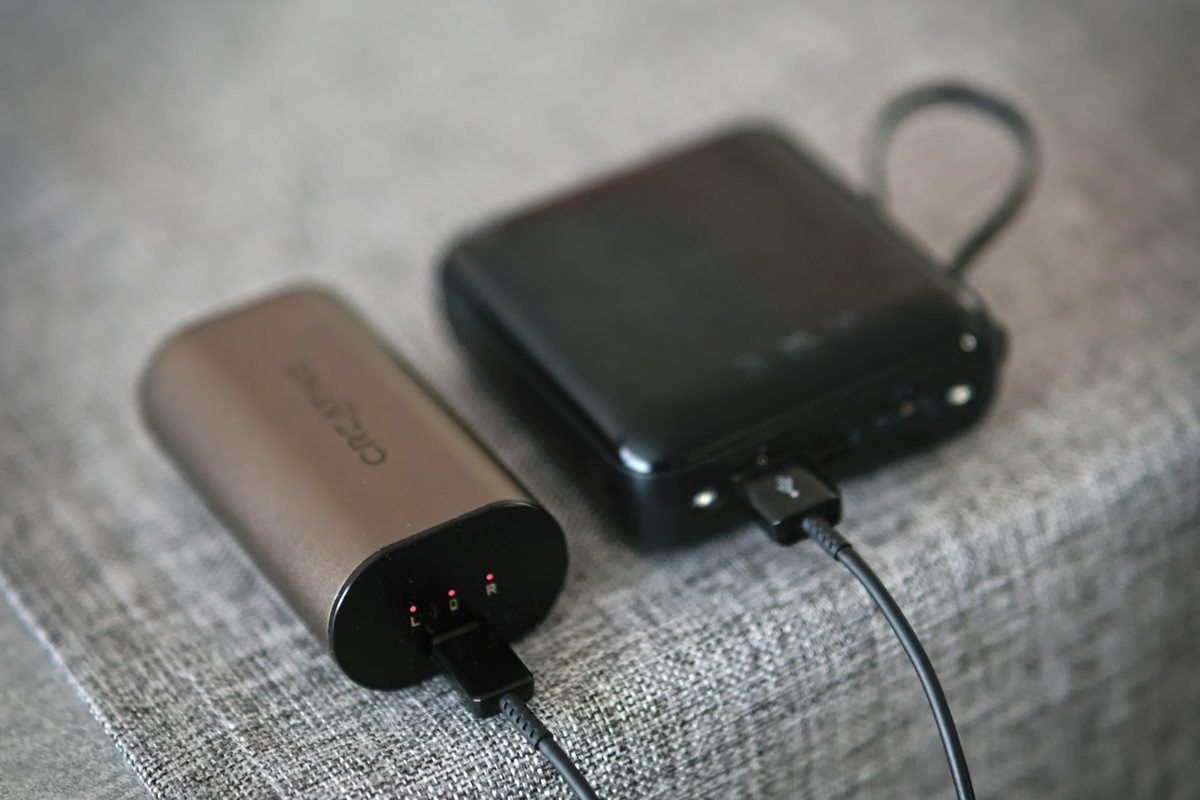
- USB-C Power Delivery (PD). Fast charging for modern phones, tablets and some laptops.
- Multiple ports. Charging two devices at once is useful for couples and families.
- Pass-through charging. Lets you charge the bank and your phone from the same outlet, useful in hotels with only one outlet.
- Built-in cable. One less thing to carry, but check that it matches your devices.
- Display. A percentage readout shows the true remaining charge.
Cables: the forgotten part
A great power bank is only as good as the cable. Choose cables that support the charging speed you need, and pack at least one spare. Short cables, around 1 meter, tangle less on trains and planes. A small pouch keeps cables, adapters and the power bank together.
Buying a power bank or cable online
Temu and other marketplaces list a wide variety of power banks and cables at low prices. Since batteries carry safety considerations, be selective:
- Look for a clear Wh rating and specifications rather than only very large mAh claims. Unrealistically high capacity for the size can be a warning sign.
- Look for information on safety certifications and protections, and be cautious if it cannot be verified.
- Read recent reviews for overheating, swelling, slow charging and capacity that falls short of the label.
- Choose a seller with a clear return policy.
- Stop using any battery that becomes unusually hot, swollen or damaged.
Charging on the go in Japan
Outlets are common in hotels and many airport lounges, but not always at cafes or on local trains. Because you will use your phone constantly for maps, translation and transit cards, a power bank is one of the most useful gadgets for a Japan trip. Pair it with our guide to Japan plugs and voltage, then plan your days with Modern Tokyo: Shibuya, Shinjuku & Akihabara or Kyoto’s historic districts.
Temu Shortlist: Listings to Browse
These are example listings and category pages on Temu that match the items above. We have not tested them, and prices, ratings, sizes and availability change often, so read the current listing, recent reviews and the return policy before you buy.
| Listing type | What to check | Link |
|---|---|---|
| 20,000 mAh power banks (browse) | Compare specs and recent reviews | View on Temu |
| 65W multi-port GaN chargers (browse) | Input range 100-240V | View on Temu |
| Power banks under 100Wh | Wh or mAh printed on the label, output ports, cable included | View on Temu |
| Slim power banks | Thickness, weight, USB-C in and out | View on Temu |
| USB-C cables | Length, rated wattage, braided cover | View on Temu |
Tip: sort by recent reviews, open the customer photos, and compare at least two or three listings before you order.
Frequently Asked Questions
What size power bank should I take on a trip?
A 10,000 to 20,000 mAh power bank covers most travelers. It provides multiple phone charges and stays well under the common 100 Wh airline limit.
Can I put a power bank in checked luggage?
Generally no. Power banks and spare lithium batteries usually must go in carry-on baggage. Check your airline’s current policy.
How do I convert mAh to Wh?
Multiply mAh by 3.7 and divide by 1,000. For example, a 20,000 mAh power bank is roughly 74 Wh. Use the Wh figure printed on the device if it is available.
Are cheap power banks from online marketplaces safe?
Some are fine, but quality varies. Look for clear specs, safety information and recent reviews, avoid unrealistic capacity claims and stop using a battery that gets hot or swollen.